
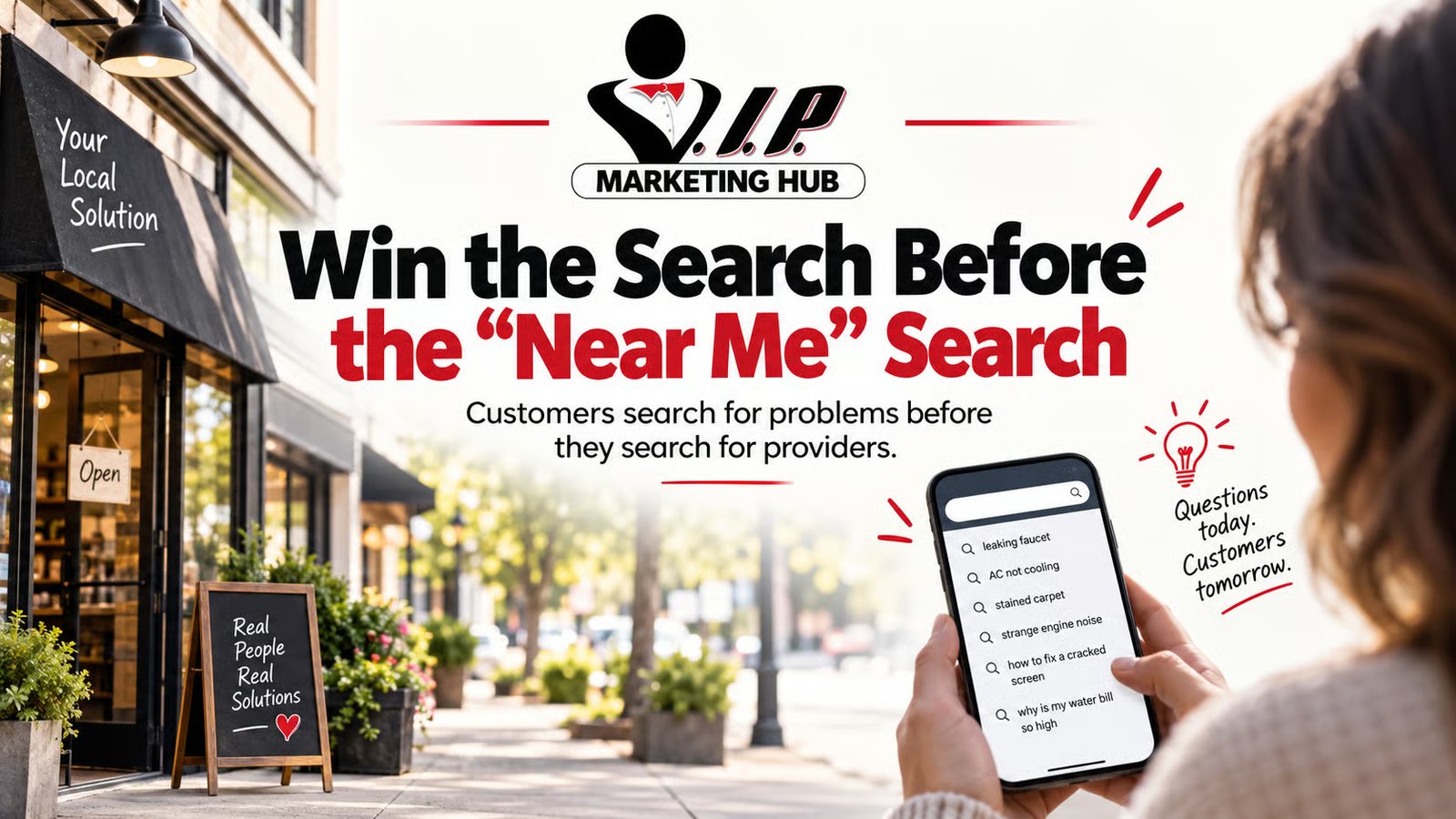
Your next customer might be searching Google right now.
But there is a good chance they are not searching for your business name. They may not even know what type of service they need yet.
Instead, they are asking a question.
“Why is my furnace blowing cold air?”
“Why does my roof leak only when it rains hard?”
“Why does my kitchen sink keep backing up?”
“Should I repair or replace my air conditioner?”
These are more than everyday questions. They represent problems that may eventually lead someone to hire a local business.
Some of the best blog topics for local businesses come directly from the questions customers ask before they are ready to call, request an estimate, or schedule service.
If your business answers those questions clearly and helpfully, you have an opportunity to introduce your company earlier in the customer’s decision-making process.
You do not need to publish constantly, chase viral content, or become a professional writer. You need to understand what your customers want to know and create useful answers around the services you actually provide.
Here’s how to do that.
Why Customer Questions Make the Best Blog Topics for Local Businesses
Most business owners organize their websites around the services they sell.
An HVAC contractor offers furnace repair, air conditioning installation, and maintenance.
A plumbing company offers drain cleaning, water heater replacement, and leak repair.
A roofing company offers roof repairs, inspections, and replacement.
Those service pages are important. They help people who already know what they need.
But customers often begin their search before they can identify the right service.
Consider the difference:
| What your business sells | What your customer searches |
|---|---|
| Furnace repair | Why is my furnace blowing cold air? |
| Drain cleaning | Why does my kitchen sink drain so slowly? |
| Roof leak repair | Why does my ceiling get wet when it rains? |
| Water heater replacement | Why do I run out of hot water so quickly? |
| AC repair | Why does my air conditioner run all day? |
| Foundation repair | Are cracks in my basement wall serious? |
| Electrical repair | Why does my circuit breaker keep tripping? |
The business thinks in services. The customer thinks in problems.
That difference creates a valuable opportunity for your website.
A plumbing company may have an excellent drain cleaning service page, but someone experiencing their first slow-draining sink might search for causes and simple fixes before deciding to hire a plumber.
A helpful article can explain common reasons for a slow drain, what the homeowner can safely check, which warning signs suggest a bigger problem, and when professional assistance makes sense.
That does not guarantee the visitor will become a customer. But it gives the business an opportunity to be discovered and build trust before the customer starts comparing plumbers.
What should a local business blog about?
A local business should blog about the problems, costs, comparisons, decisions, and common questions that customers research before purchasing its services.
The best topics are directly connected to services the business offers, demonstrate useful expertise, and help a prospective customer decide what to do next.
Five especially useful categories are:
1. Problem and symptom questions
These are searches people make when something is not working properly.
Examples:
- Why does my air conditioner run constantly?
- Why does my water heater make a popping noise?
- Why are shingles falling off my roof?
- Why do my lights flicker when the AC turns on?
- Why is water pooling near my foundation?
These articles should explain possible causes without pretending every problem can be diagnosed from one symptom.
They should also distinguish between what a homeowner can safely inspect and what requires a qualified professional.
2. Repair-or-replace questions
These searches often come from people approaching a significant buying decision.
Examples:
- Should I repair or replace my old furnace?
- Is it worth repairing a leaking water heater?
- Should I replace my roof or repair the damaged section?
- When is it better to replace an air conditioner?
Good answers discuss the age and condition of the equipment, repair costs, remaining useful life, safety considerations, and other factors that affect the decision.
The goal is not to push the most expensive solution. It is to help the reader understand their options.
3. Cost and pricing questions
Customers want to know what a service might cost before contacting a business.
Examples:
- How much does drain cleaning cost?
- What affects the price of a roof replacement?
- Why do HVAC repair estimates vary?
- Does replacing a water heater require a permit?
When writing about prices, explain what causes costs to rise or fall. Include real price ranges only when they are supported by current, reliable information.
You can also explain what an estimate normally includes and what questions customers should ask before approving the work.
4. Timing and urgency questions
Some customers are trying to decide whether they can wait.
Examples:
- Is a small roof leak an emergency?
- How long can I wait to replace a failing water heater?
- When should I schedule furnace maintenance?
- Can an AC problem wait until the weekend?
These topics give businesses an opportunity to explain warning signs, the potential consequences of delaying repairs, and when immediate professional attention is appropriate.
5. Comparison and hiring questions
These readers may be closer to making a purchase.
Examples:
- Tankless vs. traditional water heater: which is better?
- Heat pump vs. central air conditioning
- Roof repair vs. roof replacement
- What should I ask before hiring a plumbing contractor?
- What is included in an HVAC maintenance visit?
A useful comparison explains trade-offs rather than declaring one solution best for everyone.
The more clearly you help people make decisions, the more useful your content becomes.
How to Find Blog Topics for Local Businesses Using Customer Questions

You do not need an expensive SEO subscription to get started.
In fact, one of the best places to look for content ideas is inside your own business.
Step 1: Review your customer messages
Start with the questions arriving through:
- Contact forms
- Customer emails
- Text messages
- Quote requests
- Appointment inquiries
- Follow-up conversations
Look for repeated questions or concerns.
A roofing company might discover that customers frequently ask whether a roof can leak without visible shingle damage.
An HVAC business might notice repeated questions about why an air conditioner is running but not cooling the home.
Write these questions down exactly as customers ask them.
Avoid turning them into technical industry language too soon. Your customers may not use the terminology your technicians use.
Step 2: Ask the employees who talk with customers
Your office staff, dispatchers, estimators, technicians, and salespeople can be excellent sources of content ideas.
Ask them:
“What questions do you answer almost every week?”
“What do people misunderstand about our services?”
“What worries customers before they approve an estimate?”
“What usually makes someone decide to call us?”
“What do customers wish they had known earlier?”
The answers can reveal content opportunities that generic keyword tools may overlook.
Step 3: Check what appears on Google
Once you have a list of questions, search for them.
Pay attention to autocomplete suggestions, related searches, question-based results, and the websites Google displays.
Consider:
- Are the current answers clear and useful?
- Are they written for homeowners or industry professionals?
- Are they overly technical?
- Do they explain when a professional is needed?
- Is there room to add relevant local experience?
- Are established competitors already covering the question thoroughly?
Do not assume a question will be easy to rank for simply because you cannot find a nearby competitor answering it.
Large national websites, manufacturers, industry publications, and established service companies may already compete for the same search.
The opportunity is strongest when you can provide a genuinely useful answer that adds something the existing results are missing.
Step 4: Connect each question to a service
This is where you separate potential business opportunities from traffic that may never turn into revenue.
Before writing an article, ask:
“If someone searches this question, could they realistically need a service our business provides?”
For example, a plumbing company could publish an entertaining article about the history of indoor plumbing.
But a well-written explanation of why a toilet repeatedly backs up may attract readers with a more immediate plumbing problem.
Both subjects are related to plumbing, but they serve different business purposes.
Prioritize topics connected to problems your business actually solves.
Step 5: Choose the strongest question first
Do not start by writing 30 articles.
Choose one question that:
- Customers regularly ask.
- Connects directly to a valuable service.
- Has a clear, helpful answer.
- Gives your business an opportunity to contribute real experience.
- Has a plausible opportunity to reach the right search audience.
Publish that article, make sure people can find it from relevant pages on your website, and monitor its performance before expanding.
A real-world example: turning an HVAC question into a customer opportunity
Imagine an HVAC company that regularly hears this question:
“Why does my air conditioner run constantly?”
The company could publish an article explaining common possibilities, such as:
- Extreme outdoor heat
- Dirty or restricted airflow
- Thermostat settings
- Equipment sizing issues
- Insulation or air leakage
- Mechanical or refrigerant-system problems
The article could explain how unusually hot weather affects cooling performance, which basic checks are safe for homeowners, and which situations call for professional diagnosis.
It should not suggest that one symptom proves a particular mechanical problem.
At the end, the company could include a simple next step:
“If your air conditioner runs continuously and your home still isn’t reaching the temperature you set, our team can inspect the system and help identify the cause.”
That invitation feels natural because it follows a useful explanation.
Now imagine the visitor reads the article and realizes the problem may require an HVAC technician.
They already know the company’s name, have seen an example of its expertise, and have a straightforward way to request service.
That is how educational content can support customer acquisition without becoming an aggressive sales pitch.
How to write a local SEO blog post that actually helps people
Choosing the right topic is only half the job.
The article still needs to deliver a useful answer.
Give the answer near the beginning
If someone searches “Should I repair or replace my old furnace?” do not force them through several paragraphs of company history before addressing the question.
Begin with the most helpful general answer.
For example:
“Repairing an older furnace may make sense when the problem is relatively minor, the equipment is otherwise in good condition, and the repair cost is reasonable. Replacement becomes worth considering when repairs are frequent, major components are failing, safety is a concern, or the cost of keeping the system operating outweighs the value of continued repairs.”
Then explain the factors in more detail.
A reader should not have to work hard to find the information promised by the headline.
Use headings based on real questions
Instead of vague headings like “Important Considerations,” use descriptive headings such as:
- What causes an air conditioner to run constantly?
- Can a dirty air filter cause poor cooling?
- When should I call an HVAC technician?
- Is an older AC system worth repairing?
These headings help readers find the answers they need and make the structure of the article easier for search systems to interpret.
Explain when readers do not need your service
This is one of the strongest ways to make your content more trustworthy.
If a homeowner can resolve a problem through a simple, safe adjustment, explain how.
If an expensive replacement is not necessarily justified, say so.
If a problem requires an inspection before a reliable recommendation can be made, make that limitation clear.
A business that provides useful information without pushing unnecessary work can create a better first impression than one that turns every article into an advertisement.
Add something only your business knows
Generic information is easy to find.
Your direct experience with customers, local conditions, and real service situations can make an article more useful.
A roofer might explain common sources of water intrusion observed during local storm seasons.
An HVAC contractor could discuss the maintenance issues technicians frequently encounter in homes with particular heating or cooling demands.
A plumber could illustrate how a recurring drain problem was diagnosed, with the customer’s permission and without exposing private information.
Real photographs, verified examples, and technician explanations can support the written material.
Do not invent case studies or pretend to have performed work that never happened.
Does answering customer questions help with Google and AI search?
It can, provided the content is useful, technically accessible, and relevant to the questions being asked.
Traditional search engines help users discover relevant pages, while AI-powered search experiences may summarize information and link to sources.
Google’s guidance for AI search emphasizes original, helpful, reliable content and strong foundational SEO practices. It does not require a separate set of tricks to make content eligible for AI Overviews or AI Mode.
For local businesses, this suggests a practical approach:
- Answer a clearly defined customer question.
- Use accurate explanations and straightforward language.
- Include real experience where available.
- Organize the article with descriptive headings.
- Make contact details and relevant service information easy to find.
- Keep the page accessible to search engines.
For example, someone asking an AI assistant, “Why does my air conditioner run all day, and should I call someone?” may receive an explanation that draws on relevant online sources.
A useful, accessible HVAC article could potentially be considered among those sources.
But no business should assume that adding questions, FAQ sections, or structured data automatically causes AI systems to recommend it.
The most sustainable approach is to create content worth referencing.
For additional guidance, see Google Search Central’s advice on optimizing content for generative AI search.
Turn one customer question into multiple marketing pieces
A useful article does not have to sit alone on your website.
Suppose an HVAC business publishes a thorough answer to:
“Why does my air conditioner run constantly?”
That single topic can support a small content campaign.
| Format | Example |
|---|---|
| Website article | An explanation of common causes and next steps |
| Short video | A technician explaining three possible reasons |
| Social media clip | One common warning sign to watch for |
| Educational graphic | Five reasons an AC system may run frequently |
| Customer email | A seasonal cooling-system tip |
| Service page | A relevant link to professional AC diagnostics |
These pieces should complement the main article, not simply duplicate it word for word.
The website article can provide the detailed explanation. Social media can introduce the question. An email can help existing customers recognize an issue before it becomes more serious.
A good piece of educational content can support several ways people discover and interact with your business.
Don’t abandon “near me” searches
Question-based articles are not a replacement for the pages that help customers hire you.
Your Google Business Profile, service pages, location information, reviews, and clear contact options remain important.
A customer searching “emergency plumber near me” may be ready to call immediately.
That person has a different need from someone searching “Why does my kitchen sink gurgle?”
Your website should serve both.
The service page helps customers who are ready to hire.
The educational article helps people understand their problem, recognize when professional service may be necessary, and discover a business that can assist.
Make sure relevant educational articles link naturally to the corresponding service pages, and make it easy for readers to call, request a quote, or schedule service when appropriate.
How to know whether your blog content is working
Publishing an article is not the finish line.
Once Google has had an opportunity to discover and index it, start monitoring what happens.
Google Search Console can help you see which searches generate impressions and clicks to your pages.
Your website analytics can help you understand which articles attract visitors and what those visitors do next.
You can also track actions such as:
- Phone-call clicks
- Contact form submissions
- Quote requests
- Appointment requests
- Visits from articles to relevant service pages
Do not judge every educational article solely by immediate phone calls.
Some visitors are still researching. Others may return later through another channel.
At the same time, do not confuse traffic with business growth. An article receiving thousands of visits from people outside your service area may be less valuable than one that brings a handful of qualified local inquiries.
The goal is not to collect the largest possible audience.
The goal is to reach people who may eventually need what your business offers.
Frequently asked questions
What are the best blog topics for a local business?
The best topics answer actual customer questions about problems, service costs, repair-or-replace decisions, product comparisons, maintenance, and when to hire a professional. Prioritize subjects connected to services your business provides.
Can blog posts help a local business get more customers?
Yes, blog posts can introduce your business to potential customers during their research and guide readers toward relevant services. However, rankings, traffic, and inquiries are not guaranteed. Results depend on competition, content quality, website accessibility, relevance, and other factors.
How often should a local business publish blog articles?
There is no universal posting schedule that guarantees results. Start with a manageable pace, such as one or two genuinely useful articles per month, and expand when you can maintain quality and measure results. Updating an outdated, valuable article can be more useful than publishing unnecessary new content.
Should local businesses use AI to write blog posts?
AI can help with research, organization, outlining, and drafting. However, businesses should verify factual claims, add genuine experience, and review content before publishing. Generic articles with little original value are not a strong long-term strategy.
Do blog posts need to mention the city or service area?
Mention a location when it genuinely helps readers, such as when discussing local weather, permitting, regulations, seasonal conditions, or service availability. Avoid repeatedly inserting city names into unrelated sentences or creating near-identical articles for every town.
What is the difference between a service page and a blog post?
A service page explains what your company offers and helps visitors request or purchase that service. A blog post usually answers an informational question or helps readers understand a problem or decision. Both can support customer acquisition when they are connected appropriately.
Start with one question your customers ask every week
You probably already have a useful blog topic waiting somewhere in your business.
It may be sitting in an email, a text message, an estimate conversation, or a question your receptionist answers every Monday morning.
Write that question down.
Search for it.
See what information is already available.
Then create a genuinely useful answer based on what your business knows.
You do not need to become a full-time publisher. You need to make the knowledge you already use to help customers more accessible to the people searching for it.
Your next customer may not know your business name yet. But they already know the problem they need solved.
Make sure your website helps them find the answer.
Want to turn more website visitors into actual customer opportunities?
At VIP Marketing Hub, we believe attracting attention is only part of growing a local business. The next step is making it easy for interested customers to contact you and ensuring those opportunities receive the attention and follow-up they deserve.
Learn more about how VIP Marketing Hub helps home-service businesses capture, follow up with, and retain more customer opportunities.

I’m Ed Porada, founder of VIP Marketing Hub. We help small and local businesses improve their online visibility, generate leads, build trust through reviews, and turn more website visitors and inquiries into customers. Our work includes local marketing, websites and conversion, reputation management, customer follow-up, and practical AI and automation. I share useful marketing ideas through the VIP Marketing Hub newsletter to help business owners make clearer decisions and take action without adding unnecessary complexity.