
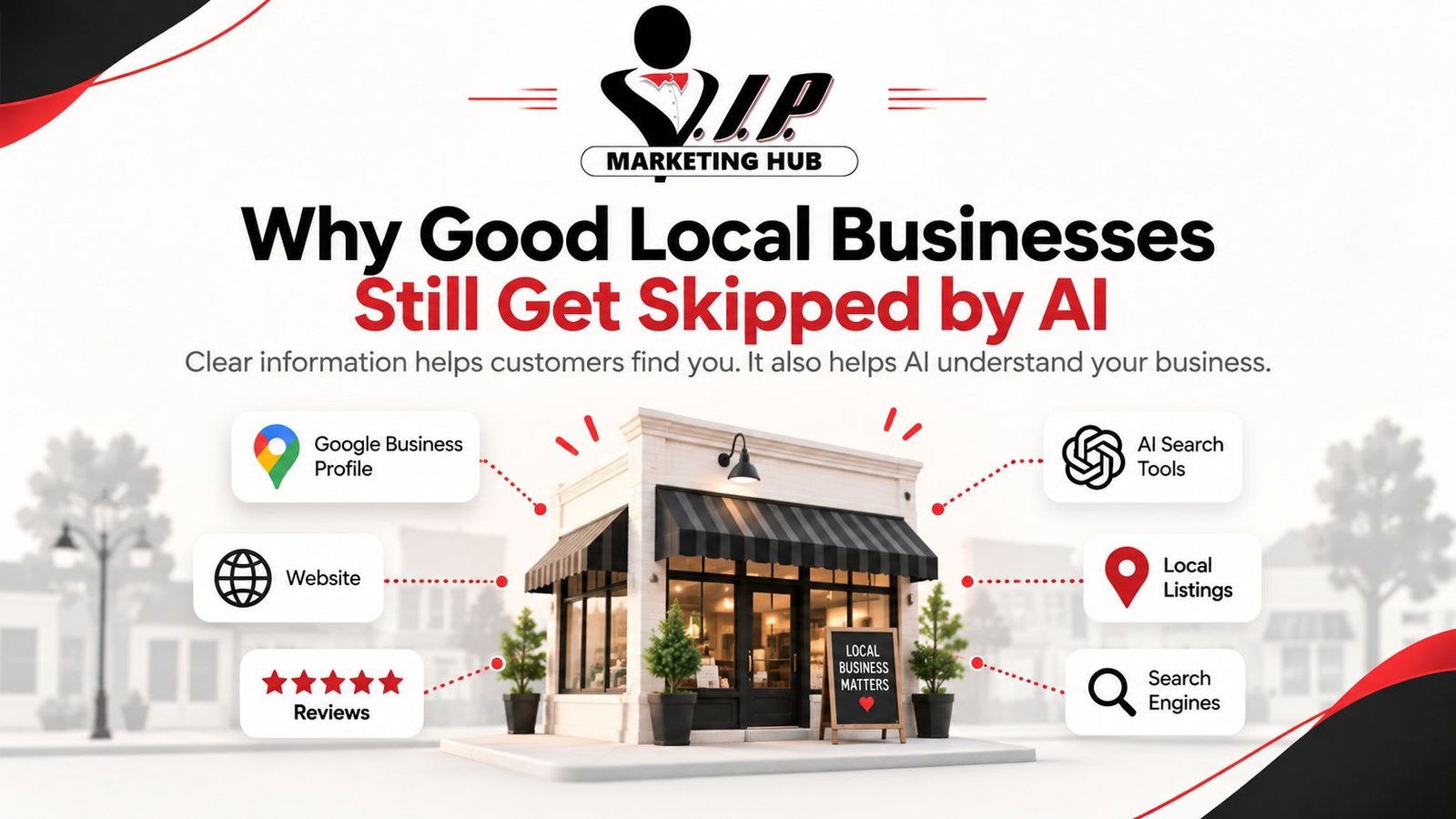
AI visibility for local businesses starts with clear, accurate information. Here is how to check what customers and AI tools can find about your business.
You can have good reviews, a solid website, and a Google Business Profile that looks fine, yet still be absent when someone asks an AI tool for a local recommendation.
That does not automatically mean anything is wrong with your business. AI-assisted answers can vary by platform, location, wording, and the sources available. Sometimes your public information is simply thin, outdated, vague, or difficult to connect.
AI tools do not know your business the way your customers do. They work from information they can find. If your website says one thing, your business profile says another, and your service pages barely explain what you do, people and technology have a harder time understanding what you offer.
You do not need a mysterious AI trick. Start by making your business easier to understand.

Photo by Vitaly Gariev on Unsplash.
AI visibility for local businesses starts with clarity
Imagine someone asks, “Who repairs air conditioners in [town]?” or “Who is a good family dentist near [neighborhood]?” Clear public information helps a person researching your business understand what you offer, where you work, and whether your services fit their needs.
The basics still matter: your Google Business Profile, website, service pages, reviews, business listings, and the questions you answer publicly. AI may feel new, but clear information is not.
Check your Google Business Profile for AI visibility
For many local businesses, a Google Business Profile is one of the places customers use to learn who you are, where you are, and what you do. Review it as if you were a stranger seeing it for the first time.
- Are your hours and contact details correct?
- Are your services and categories current and accurate?
- Do you have recent, genuine photos?
- Does your description explain the business in plain language?
You do not need to post every day. Make sure the information customers see is useful and up to date. Ask yourself: if someone only saw this profile, would they understand what you do and how to contact you?
Write clear web pages to improve AI visibility for local businesses
Many local business websites read like brochures: “We offer furnace repair, AC installation, and maintenance.” That lists services, but it may not answer what a customer is trying to figure out before calling.
A homeowner might ask, “Why is cold air coming out of my vents?” “Is this worth repairing?” “Should I shut the system off?” or “How quickly can someone come out?” Those are real questions. Answering them makes your website more useful to people choosing a provider and gives search and AI tools clearer information about what your business knows and does. Clear answers are a practical foundation for AI visibility for local businesses.
You do not need a long article for every possible question. Start with clear answers to questions customers already ask you.
Use FAQs to improve local business AI visibility
If your staff answers the same five or ten questions every week, those answers may belong on your website. Use the customer’s wording, answer directly, and add local details when they genuinely matter.
Explain when someone can handle a simple issue themselves and when it is time to call a professional. This kind of useful content can keep helping customers long after a generic “Call us today” paragraph has been forgotten.
Keep business information consistent to improve AI visibility for local businesses
Check your business name, address, phone number, and website across Google, Yelp, Apple Maps, Facebook, and your own site. Do they match? An old phone number, previous address, or broken link can confuse customers and make your public information harder to piece together.
Consistency will not put you at the top of every result. It does make your business easier for people to identify and understand, which is a worthwhile goal by itself.
Run a five-day AI visibility check for local businesses
- Day 1: Review your Google Business Profile and correct anything incomplete, outdated, or inaccurate.
- Day 2: Improve one important service page with answers to questions customers ask before choosing that service.
- Day 3: Add or improve FAQs using real questions from calls, emails, texts, and conversations.
- Day 4: Check major business listings for consistent contact information.
- Day 5: Ask ChatGPT, Perplexity, and Google questions a customer might ask about your business category and town. Save what you see and note which sources are mentioned.
Treat the last step as a snapshot, not a scientific ranking report. Results can change with the tool, location, question, and timing. You are looking at how your business appears from the outside.
Where AI Shortlist fits
These steps give you a practical place to begin. If you want help improving how your business is understood in AI-assisted search and recommendations, AI Shortlist is VIP Marketing Hub’s AEO service. It focuses on making your business information clearer and easier to interpret across the places customers look.
No AEO service can guarantee that a particular AI platform will recommend a business or show it in every answer. The goal is to improve the clarity and usefulness of your public information, then check what changes over time.
Frequently asked questions about AI visibility for local businesses
Do good reviews guarantee an AI recommendation?
No. Reviews can help customers judge a business, but no single review count, profile, or website change guarantees that an AI tool will mention or recommend it.
Why does my business appear in one AI tool but not another?
AI answers can vary by platform, question wording, location, timing, and the sources each tool uses. Treat a check as a snapshot, not a definitive ranking report.
What does AEO mean?
AEO means Answer Engine Optimization. It is the work of making useful, accurate information easier for answer-focused search tools to interpret. It cannot guarantee a specific placement.
Does every local business need a separate FAQ page?
No. Put clear answers on the service or location pages where customers need them. A separate FAQ page makes sense only when it helps people find answers more easily.
How should I test my AI visibility?
Write down a few realistic questions that include your service and town. Try them in more than one tool, record the date and sources mentioned, then repeat later using the same questions. Look for patterns, not a perfect score.
Build clarity instead of chasing AI tricks
Your job is simpler: make your business easy to identify, explain clearly what you do, answer the questions customers actually ask, and keep important information accurate. Then periodically check whether the tools people use can make sense of it.
Reviews matter. Clear, accurate information matters too. Both help people make a more informed choice.
What did AI say about your market?
Have you asked ChatGPT, Perplexity, or Google for a recommendation in your category and town? Compare what you see, and tell us what surprised you. If you want help with AI visibility for your local business, contact VIP Marketing Hub to ask about AI Shortlist.

I’m Ed Porada, founder of VIP Marketing Hub. We help small and local businesses improve their online visibility, generate leads, build trust through reviews, and turn more website visitors and inquiries into customers. Our work includes local marketing, websites and conversion, reputation management, customer follow-up, and practical AI and automation. I share useful marketing ideas through the VIP Marketing Hub newsletter to help business owners make clearer decisions and take action without adding unnecessary complexity.