
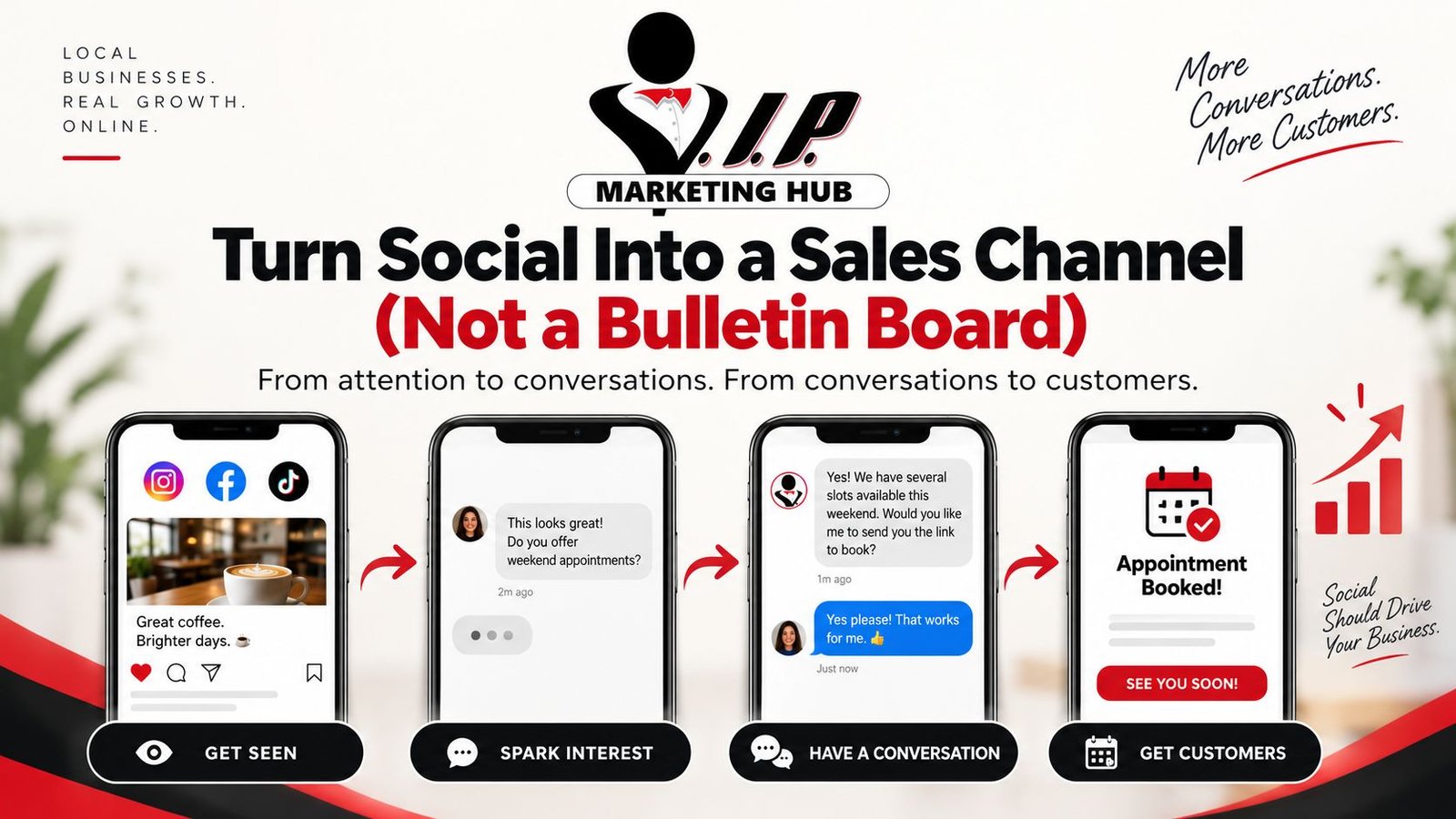
Social media for local businesses can do more than show activity. A clear profile, quick replies, and useful follow-up can turn attention into customer conversations.
Posting a product, recent job, or special can show that your business is active. The next step is helping interested people understand what you offer and how to contact or book with you.
Many local businesses use social media like a digital flyer rack: a new product, a before-and-after photo, a finished project, a weekly special, or a quick greeting to followers. None of that is wrong. People want to see that you are active and doing real work for real customers.
But posting alone is not a sales process. Someone who visits your Facebook or Instagram profile may already be deciding whether to call, book, visit, or ask a question. Your profile should make that next step easy.
That means your bio should be clear. Messages should not sit unanswered. Comments should lead somewhere. Interested people should not disappear because nobody followed up.
You do not need to post more. You need to get more business value from the attention you are already receiving.
Social media for local businesses: make the next step clear
A lot of business profiles use valuable space for statements like “Family owned since 1998,” “Quality you can trust,” or “Serving the community.” Those statements may be true, but they do not tell a new visitor what to do next.
A useful bio should quickly answer four questions: What do you do? Who do you help? Where do you serve? What should I do next?
A family dentist might write: “Family dentistry in [neighborhood]. New patients welcome. Book online.”
An HVAC company might write: “AC repair across [city] and nearby towns. Call or text to schedule.”
A salon might write: “Cuts and color for busy professionals in [area]. Book your next visit.”
Clear beats clever. Send people to the next step that matters, such as a booking page, quote request form, phone or text link, or a relevant service page. That is the practical job of social media for local businesses: make the next step easy to find and act on.
Social media for local businesses: treat DMs like customer conversations
A direct message can be casual, but it can also be a customer raising their hand. This is one reason social media for local businesses needs a simple way to monitor inquiries. Someone may ask a salon about openings, a clinic about new patients, or a contractor whether they can fix something shown in a photo. Those are messages you do not want buried for two days.
You do not need to live inside Instagram or Facebook all day. You do need a simple response system. If your platform and account setup allow it, an automatic reply can confirm that a message arrived, say when the person can expect a response, and offer a useful next step.
For example: “Thanks for reaching out. We usually reply within [your actual response window] during business days. If you want to get started now, you can book here: [link].” Use a response window your team can meet. Do not promise a quick reply if you cannot consistently provide one.
Meta’s instructions explain how to create an automated Messenger greeting for a Facebook Page. The available options can vary by platform, account, and settings.

When you reply personally, treat the conversation like a phone inquiry. Find out what the person needs, ask the right questions, and give them a clear next step. A DM is still a customer conversation.
Social media for local businesses: answer comments before moving the conversation privately
Someone asks, “Do you take new patients?” “How much for a color and cut?” “Do you install heat pumps?” or “Is this available today?” Some businesses ignore the question or reply only, “DM us.” That puts the work back on the customer.
Give a helpful public answer first. This two-way approach helps social media for local businesses build trust with everyone reading the comments. If you are accepting new patients, say so. If a price depends on details, explain what information you need. Then, when appropriate and the platform allows it, offer to continue privately: “Saw your comment. Would you like me to send a couple of available times?”
The public answer may help other people who have the same question. The private conversation gives you a chance to help that person move forward. Questions in comments can also become useful content ideas. See our guide to blog topics for local businesses for more ways to turn customer questions into helpful content.
Use Stories to start simple conversations
Stories can feel more casual than a regular post, which makes them a useful place to ask an easy question. A simple prompt can make social media for local businesses more conversational. Instead of only posting “busy day today,” give people something specific to respond to.
- A salon could ask, “Which are you thinking about next: cut or color?”
- A restaurant could ask, “Which special should come back next week?”
- A contractor could show a before-and-after and ask, “Would you have repaired this or replaced it?”
- A shop could show two new products and ask which one people prefer.
You are not trying to become an influencer. You are giving customers an easy reason to interact with your business. When someone responds, answer them.
Follow up when a conversation goes quiet
This is where some opportunities disappear. Someone asks about price, you answer, they say, “Let me think about it,” and then everybody gets busy. A couple of days later, the conversation is buried.
One calm follow-up can reopen the conversation: “Wanted to circle back on your question. If you still need help, I’m happy to answer anything else.” Or: “If timing is the issue, I can send you a couple of other options.”
Follow-up is part of social media for local businesses, too; it can keep a promising inquiry from ending after the first exchange. About 48 hours can be a reasonable starting point, but there is no magic number. Choose a follow-up time that fits the customer and the type of service. Do not assume silence always means no. Sometimes people simply get busy.
Help interested people take the next step
For social media for local businesses to support sales, the next step after attention has to be clear. Keep posting your work, sharing useful information, and showing people that your business is active. Also look at what happens after someone notices you. Can they tell what you do? Can they see what to do next? Do messages get answered? Do questions turn into conversations? Does anyone follow up?
You do not need to become a full-time content creator. Make your existing social presence better at helping interested people become customers.
Frequently asked questions about social media for local businesses
What should a local business include in its social media bio?
Say what you do, who you help, where you serve, and what the visitor should do next. Link directly to the most useful action, such as booking, calling, texting, or requesting a quote.
How quickly should a business respond to social media messages?
Set a response window your team can reliably meet and check messages during business hours. If you use an automatic reply, make sure it gives an accurate expectation and a helpful next step.
Should a business answer customer comments publicly?
When the question is general, answer it publicly so other readers can benefit. Move personal details or a service-specific conversation to a private message when appropriate.
When should I follow up on a social media inquiry?
There is no universal timing. A polite follow-up after a couple of days can be a reasonable starting point, but adjust it to the customer’s needs and the type of service. Avoid repeated messages if the person has declined or asked you to stop.
Do I need to post every day to get business from social media?
No. A clear profile, useful posts, timely replies, and consistent follow-up can make your existing social presence more helpful without requiring daily posting.
Which part of your social setup needs work?
This quick review can show where social media for local businesses is losing interested people. Which part needs the most attention right now: your bio, direct messages, comments, or Stories? Start with that one. Improve the next step, set a response routine, or add a reminder to follow up. If you want help making your marketing easier for customers to act on, contact VIP Marketing Hub.

I’m Ed Porada, founder of VIP Marketing Hub. We help small and local businesses improve their online visibility, generate leads, build trust through reviews, and turn more website visitors and inquiries into customers. Our work includes local marketing, websites and conversion, reputation management, customer follow-up, and practical AI and automation. I share useful marketing ideas through the VIP Marketing Hub newsletter to help business owners make clearer decisions and take action without adding unnecessary complexity.